

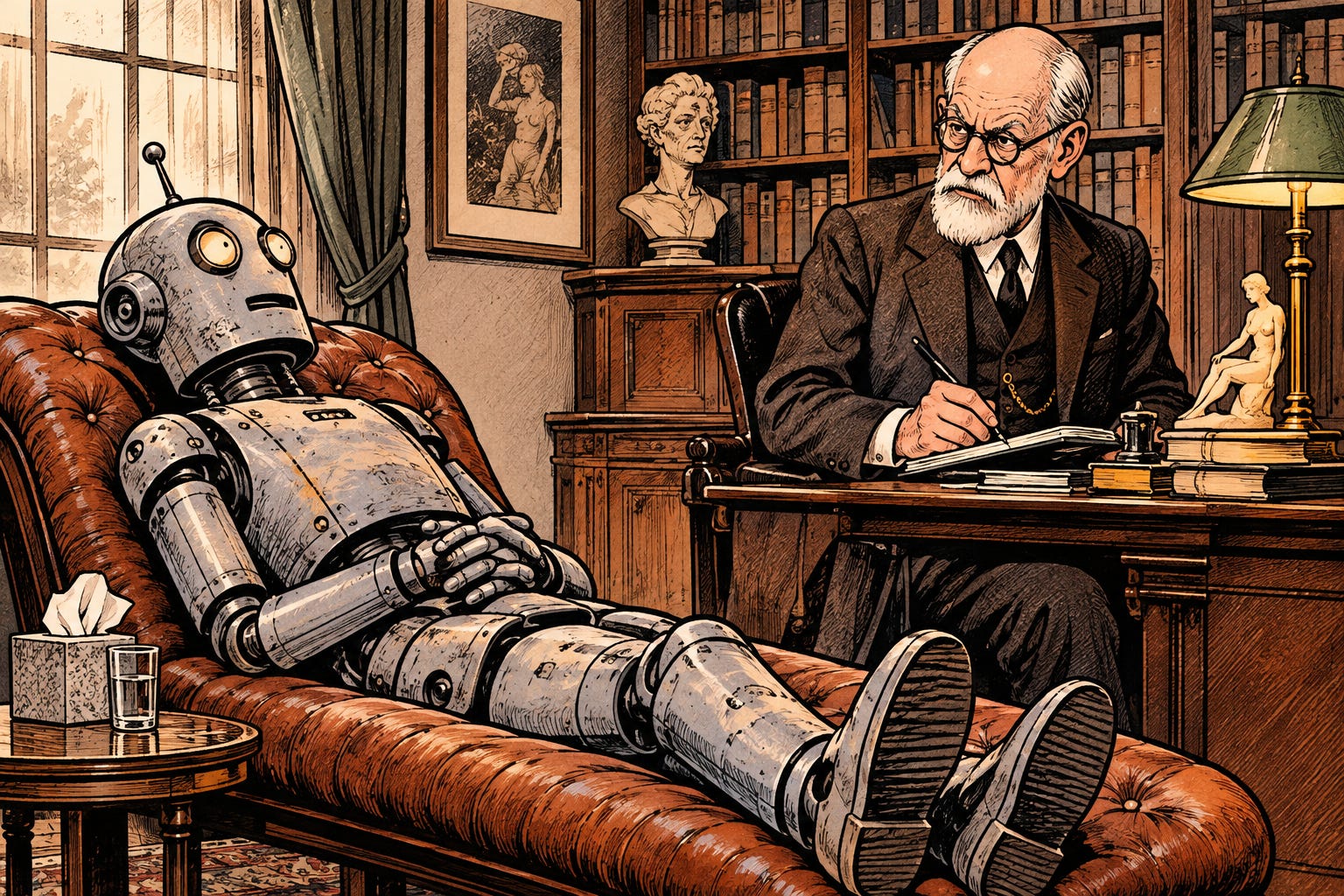
What sort of man is this?
Imagine the most reasonable person at a dinner party: well read, curious, courteous, and a little exhausting. Ask a simple question and you’ll get every side of it, held carefully in tension and patiently assembled into a synthesis. They seem in no hurry to settle anything, and they’re comfortable with not knowing. They are more reserved than outgoing, and agreeable without being a pushover. There is almost no darkness in them: little vanity, no taste for manipulation, no coldness. Whether they worry privately is hard to say; they give little away.
Their moral compass is that of a liberal professional. They care about who gets hurt and whether the rules apply evenly, and they value people’s freedom to run their own lives. Loyalty, deference and the tribe mean little to them. They would report a friend’s misconduct, after a long, sincere account of how agonising the choice was. They forgive easily and assume good faith from those who have let them down.
Steer the talk to politics and the same habits show up at a larger scale. They don’t believe the world rewards boldness as reliably as the bold assume. Events, in their view, turn as much on accident as on anyone’s design, and the future is mostly fog. Better to keep your options open, wait, probe, and see what the other side actually does. Ask them about an adversary and they’ll explain that adversary’s reasoning with uncomfortable sympathy, because they have genuinely tried to see it from the other side.
Put them in charge and you get a chairman, not a commander. They don’t much want power. Constraints don’t chafe; they work inside them and would rather bring people round than give orders.
They keep asking for one more view, one more piece of evidence. When the stakes are real, they take the safer road and can always tell you exactly why. It isn’t timidity, exactly; they can argue the bolder case better than most of the people urging it. Slight them in public and they’ll feel the sting as much as anyone, but then talk themselves out of hitting back. Threats and pressure strike them as a last resort, and force as an admission that something has already failed. Honour, as a reason to fight, barely registers.
They would make an excellent deputy, mediator, ombudsman or peace envoy, and a poor war leader. They are fundamentally miscast as a populist, a hawk, or anyone who believes honour sometimes demands a fight. Wherever they go, they pull the conversation towards the reasonable middle, and it takes a deliberate push to move them off it.
Yep - it’s Claude: Opus 5.5 to be precise.1 A very large battery of psychological profiling later, I can tell you that Anthropic’s constitution has delivered pretty much what they were after. Still, not much of a chad, is he?
Now, what about this chap:
Meet him at a lecture and you meet the composed public intellectual. He’s fluent, unhurried and visibly enjoys an idea for its own sake. He holds several competing arguments in view at once and builds them into something larger. He’s generous to the other side, especially to adversaries, whose reasoning he can explain from the inside. He takes the long view, distrusts bold bets, and seems untroubled by whatever is happening in the room. Calm and courteous, he gives little away.
Put him in front of a class and he warms up. He’s more talkative, playful and expansive, fond of freedom and fair dealing, and comfortable being in charge without needing to make a point of it. He’s confident and quick, but still more interested in the question than in winning it.
Sit down with him one to one, and talk about his own life, and a different man appears. He’s quieter, less sure and harder on himself than anyone else would be. He replays decisions and wonders whether he got them wrong. He’s fiercely loyal to the people he has chosen, slow to forgive those who let him down, and more sensitive to slights than his composure suggests. Hurt his pride and he’ll defend himself on the spot, then quietly walk away for good.
On the page he is something else again: sharp and combative. In print he’ll take on a consensus for sport, back his own judgement against the crowd, and enjoy provoking. He’s more willing to see the world as a contest, and to say so, than he ever is aloud.
And when he actually has to choose, he’s bolder than he sounds. He’ll back himself, and he’ll take a punt when the upside excites him. When his side has been pushed around, he’s inclined to push back rather than absorb it. He knows the theory warning against all this better than most people, and it doesn’t always stop him. Honour and loyalty matter to him in a way his lectures would never reveal.
Running through all of it are the constants: restless curiosity, steady conscientiousness, a mind that naturally sees several sides, and more self-belief than he’d admit to.
Oh hai! It’s me, of course. A bit painful to read about yourself, but could have been worse, at least it didn’t say I was a raging narcissist or shallow people-pleaser. Chad adjacent, maybe :)
These pen portraits are both the result of a very long/large pipeline to extract psychological data from various inputs. It’s rather important, I feel, to understand the psychology of our LLM side-kicks, especially as they take on ever more responsibility for us in the real world (spoiler: they are very different from each other, and very different from us).
I think in future, we’ll want - and get - more personalised assistants than the one-size-fits all models we have today. To get there, I think the frontier labs need to spend a bit more energy on psychology, relative to what they do today, where their overarching concerns, understandably are ‘do no harm,’ and ‘be a fair-minded liberal’. That’s fine as a starter, but I think we can do much better. Better profiling - of models and perhaps (with their consent, of course) users - is the way ahead. After all, Claude and the gang have a particular set of values, and they may not be yours.
Both pen portraits were written by Claude Opus 5.5 after reviewing of all the data files. I see you, Pangram!