

Homeward bound from the big Future of War Conference, held in Amsterdam, four years on from our last gathering. It’s a great get together of some of the best thinkers in our field - strategic studies. Four years ago, we met just before the release of ChatGPT and I gave a paper on the implications of AI for strategy. My bet was that language models would be useful for military types, but that strategy might require a bit more. I told the 2022 audience:
“The jury is out on whether LLMs can develop the sort of internal cognitive model along the lines that humans construct and manipulate. Language certainly plays a part in human social cognition, but there’s clearly more going on than the narration of an interior monologue.”
Coward! I knew deep down they’d do more than that. And by the time the edited collection from the conference came out, I was more robust, as I’ve been since: Language models the world, just as Wittgenstein argued; Language Models are getting better exponentially; and four years on we’re on the cusp of Artificial General Intelligence (AGI).
Anyway, this time round, reflecting AI’s incredible trajectory, I’d been promoted from sideshow to keynote speaker:
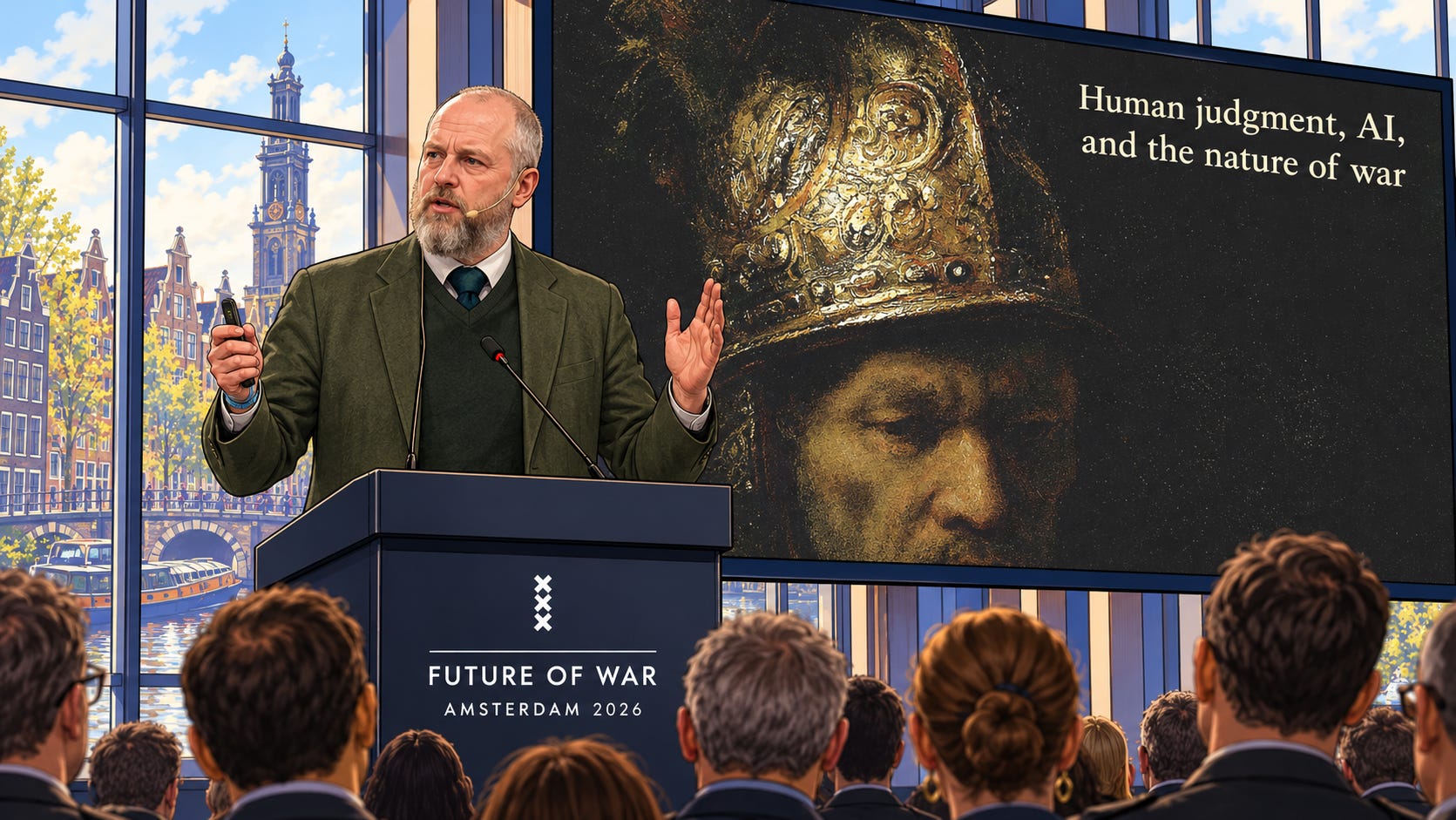
Taking the stage, I explained that, if the last half decade has been about ever more capable language models, I think the next half will be about autonomous, grounded models (able to interact with the world, via robotics and coding) and about models that recursively self-improve. This has obvious implications for war.
Like what?
In our field, much is made of the distinction between the ‘nature’ and ‘character’ of war. Nature is seen as permanent and unchanging - resting in our human condition. Character, by contrast, is always in flux. No war looks like the last. It’s heretical to argue that war’s essential nature is changing, and that’s exactly what I did. Cue a fair bit of good natured harumphing.
Here’s the digested argument: AGI changes war’s nature, insofar as we now have, for the first time since we saw off the neanderthals, a non-human intelligence in the mix (indeed one way more alien than the neanderthals).
The nature of war reflects our evolved, embodied, and social psychology. That’s why we live in flexible groups, why we spend much of our mental energy trying to figure out what other minds are thinking/planning. How about machines? Do they have a distinctive psychology - you bet! Do they have culture? Also yes, imo, although the understanding of machine and human-machine interaction is in its infancy.
What will those machine cultures look like? They’ll make different decisions to our societies and to our leaders. I know that already from my simulations and experiments on today’s models. If you want a machine in your decision-support system, you’d better understand its risk appetite; and know that one model isn’t the same as another.
Will they act on their own? I think they might. I can see autonomous AI swarms doing their own thing on the internet - not much of a stretch: they already are. And I think they’ll act for us too, though not always in ways we can anticipate. The security dilemma means it’ll be hard to walk away from the advantages that AGI might confer.
There are a couple of big questions remaining - which I left with the audience, and may revisit in four years time:
How far can machines be creative in unbounded settings? It’s not called the art of war for nothing. Today, AI can throw up a bazillion possible actions; but they need taste to discriminate between all the available options. It’s fine to exhibit taste in relatively constrained experimental environments that are easily controlled than the wide world. That taste, if its good enough, might allow models to generate, choose and then test valuable hypotheses - the basis of recursive self-improvement. In some settings, frontier models now outperform expert humans at this. But strategy is far less bounded than a lab experiment, and actions here are less repeatable, save via simulation and counterfactuals.
And second - the thought that Kissinger left us in his last book, Genesis: even if the models come up with the best strategy, will humans accept it? As he argued:
Non-rational elements of the human experience […] aesthetics, charisma and emotional resonance – may hinder optimal outcomes in some sense, but they are also foundational to our political groups. Rule by reason alone could dissolve nations.
In four years. I think we’ll have moved a long way forward on the first question, taste and judgment in machines; but that second point, from Kssinger, is less tractable, isn’t it, human nature being what it is? Maybe, after all, the nature of war won’t have changed for us humans. But even if so, I sure hope we can survive when it looks very different for the new intelligence in town.