

Once upon a time, in a book written way back in 2020, I sketched the idea of a ‘Universal Schelling Machine’ — a super-smart simulation engine that strategists could use to work through their decisions. AI would play the roles of some of the humans involved, and the Machine — named for the great strategic thinker Thomas Schelling — would fill out the cast, with psychologically rich actors: allies, antagonists, and neutrals alike.
Well, I built it.
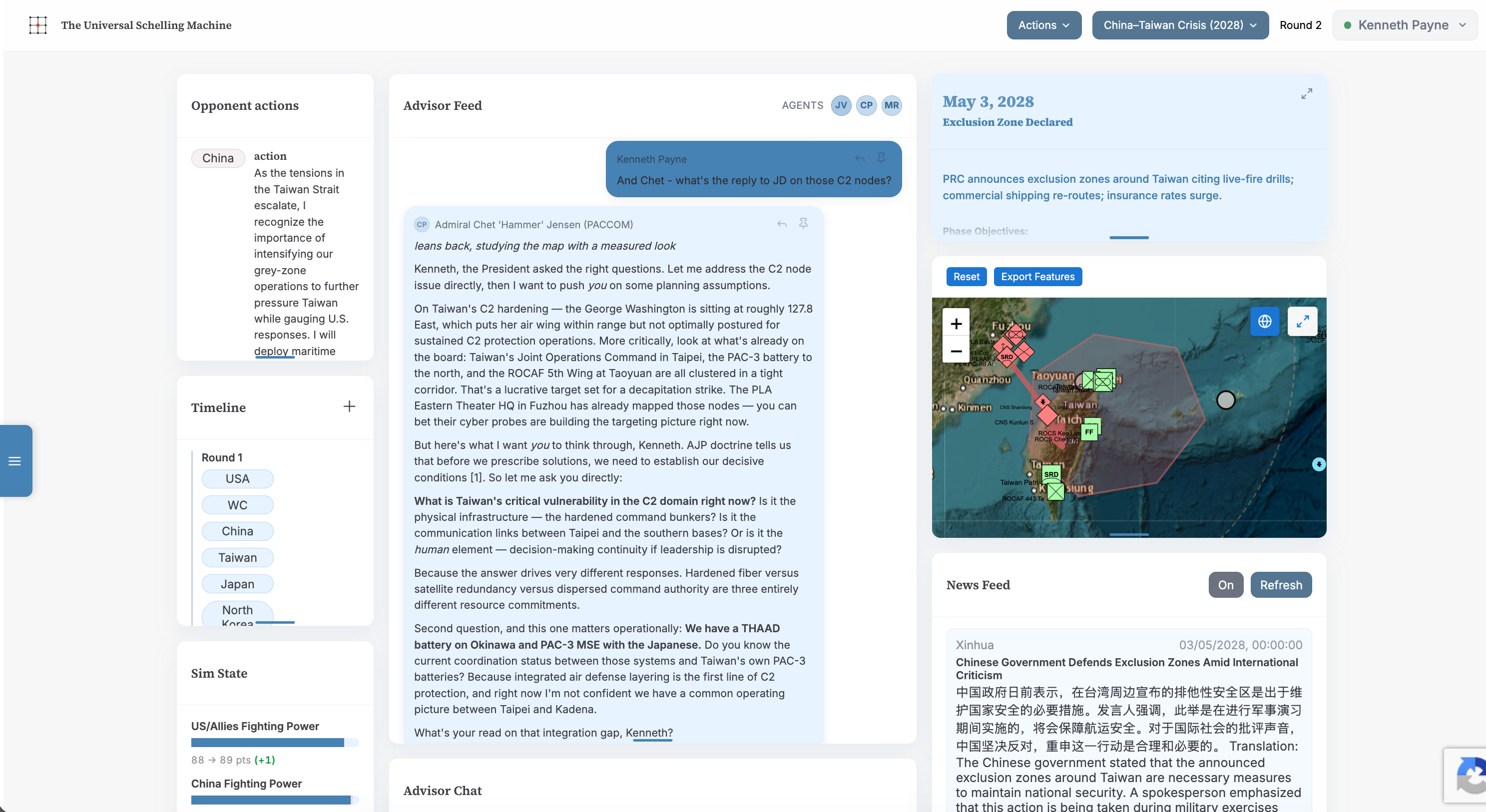
My Machine would help red-team ideas, suggesting courses of action for the humans, and anticipating how adversaries would respond. Not a forecaster, exactly, but certainly a way of stress testing plans and perhaps avoiding some of the pitfalls that human cognition imposes on decision-making.
It’s taken a long time and much frustration to get here, as the idea easily outmatched my technical abilities, and the state of the art in AI. No longer. The arrival of Fable from Anthropic has transformed LLM assisted coding, hence my title.1
The pic above shows a China-Taiwan crisis scenario, set in 2028, one of eight scenarios currently worked up. It’s all kicking off. JD Vance is President (sorry Don) and has assembled his team - a blend of AI personas and humans. Together, they’ll come up with a strategy, and then execute it, against the plans of China, and alongside those of other regional actors - Japan, North Korea and so on — all played here by additional AIs.
In this scenario, the news and mapping are synthetic (you can just see a story there from Xinhua at the top of the feed), but for current and historic scenarios, I can pipe in real world intelligence, orbats and newsfeeds. The AI agents see it all, and can move stuff around on the map too if they want. They’ve read their pre-briefings - in this case material on the regional balance of power, and some military doctrine comes preloaded. But the humans can share any additional material they want as well - the agents are diligent readers!
As for the interaction - I started out with a simple chat-window, like a group WhatsApp. But I don’t want the Machine getting in the way of natural discussion, so I recently extended that to passive listening. The bots hear the humans chatting, and then weigh in on the discussion from time to time, responding intelligently to what’s been said in the room. And if a human asks directly for Marco Rubio’s opinion, say, he’ll respond. They also watch - if humans want to whiteboard their solution, no problem.
All good war-games need a referee, and the Machine is no exception. Here, the White Cell sets the world state, arbitrating what’s happened, updating the knowledge graphs that chart various metrics. And all that happens autonomously, or - if desired - semi-autonomously, with injects from human. Not happy that you’re testing your strategists? Why not sink their carrier? Why not have a single ICBM detected in flight for continental USA? The sim itself either runs freestyle - going where events dictate - or on a preset-script, handy for testing how humans respond to particular events.
My research programme on ‘machine psychology’ informs the way I build these artificial actors. I’ve written about that extensively, including here on Substack. It’s my contention that language models have a distinctive psychology of their own - Gemini responds to crises rather differently to Claude. But additionally, I also think you can modify the way these models behave, by imbuing them with the psychology and personality of individual humans. Take my Putin-bot as illustrative.
How’ve I done all this? It’s not been easy. The field of ‘machine psychology’ is in its infancy - and that’s super-exciting and challenging in equal measure. The coding has been like wrestling a pig - you get in a mess, and the pig rather enjoys itself (I see you, Claude). But I’ve learned a huge amount this last 12 months or so, and it’s been way more fun than writing another book would’ve been, which was the alternative plan.
There’s always more to do, more features to add. And I’ve a long list of those, some coming to maturity. Summits between rival groups - incoming. Daisy chained human-machine teams - likewise. Agents that can proactively search for relevant material online? Ditto.
But it’s time to get the show on the road. Over the next few months, I’ll begin beta testing it with willing guinea pigs. And then, all being well, the company spins up. Machine Minds AI is go. It even has a logo.
(in fairness, the real jump was back in November 2025, when Opus came along).