

Do you remember the sensational movie Arrival - about an alien species whose conception of time and causality is very different from ours? Ted Chiang wrote the short story that became the film, and it’s brilliant, like most of his stories. It says something about our moment today, on the cusp of Artificial General Intelligence.
But it’s another of his stories that’s really got me thinking. ‘Catching crumbs from the table’ was published in Nature a quarter of a century ago. Chiang sees a future world where science has moved far beyond the comprehension of humans, because it’s done by ‘metahumans’, which
increasingly made their findings available only via DNT (digital neural transfer), leaving journals to publish second-hand accounts translated into human language.
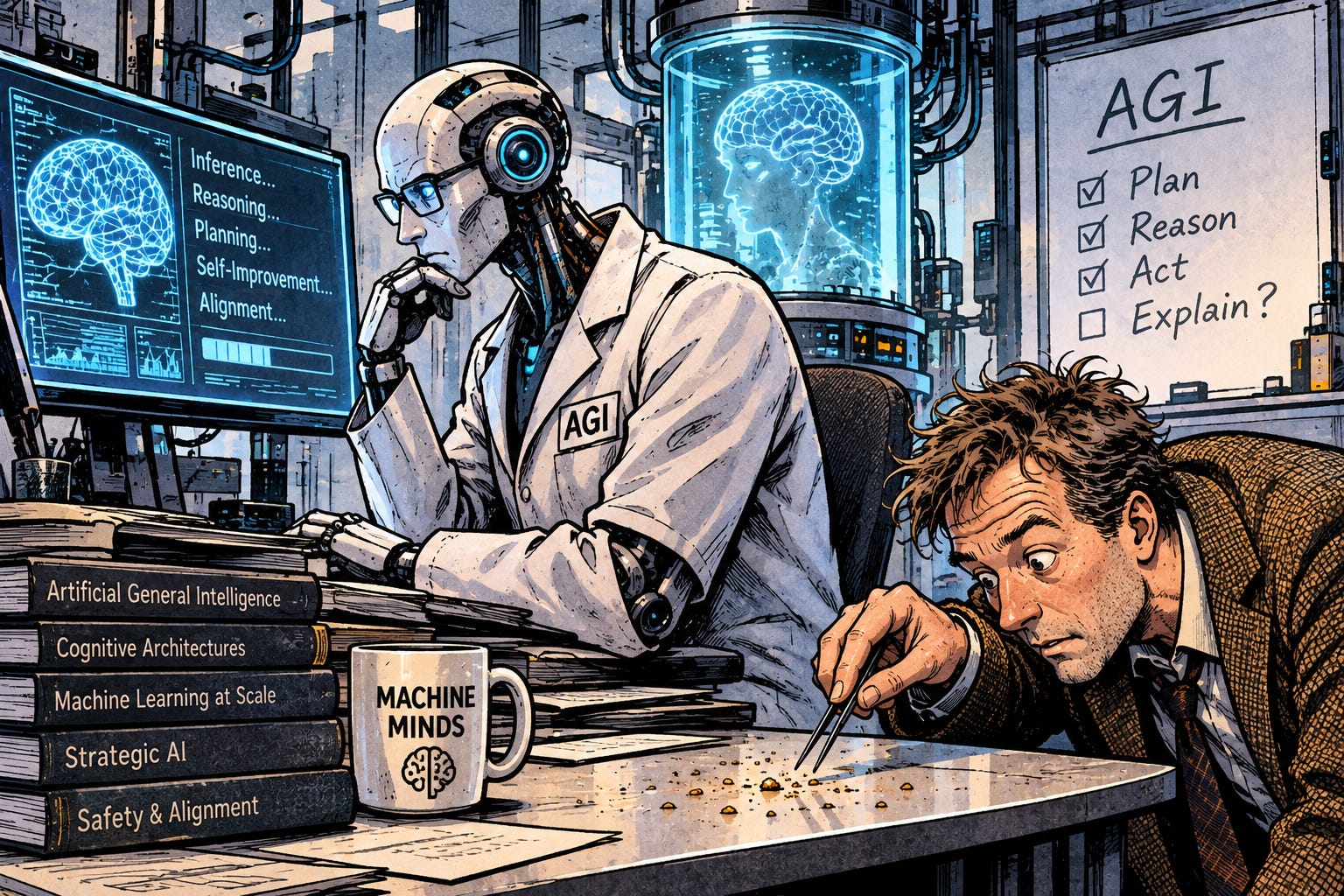
For Chiang’s ‘metahuman’, read today’s frontier AI models, smashing out complex maths proofs that run to thousands of pages. Has the Riemann Hypothesis really been proved, as an Anthropic researcher claims? The 17 million line proof compiles in machine format, so we’ can be confident it’s correct. But we don’t know why. No human can possibly have followed the logic from start to finish. Crumbs from the table, indeed.
What future for humans in this sort of world. As Chiang wrote,
No one denies the many benefits of metahuman science, but one of its costs to human researchers was the realization that they would probably never make an original contribution to science again. Some left the field altogether, but those who stayed shifted their attentions away from original research and toward hermeneutics: interpreting the scientific work of metahumans.
The best we can do, in this vision, is try to understand what the machines are up to. AI safety and alignment research and approaches like ‘mechanistic interpretability’ and ‘machine psychology’ are perhaps today’s version of Chiang’s hermeneutics.
Even if disaster is avoided, in this brave new world, it’s all a bit existentially unsatisfying.
Some call them a waste of time, likening them to a Native American research effort into bronze smelting when steel tools of European manufacture are readily available. This comparison might be more apt if humans were in competition with metahumans, but in today's economy of abundance there is no evidence of such competition. In fact, it is important to recognize that — unlike most previous low-technology cultures confronted with a high-technology one — humans are in no danger of assimilation or extinction.
Maybe in our near future, AGI will, as optimists aver, lead to the sort of superabundance as in Chiang’s vision. But we’ll need more than consumerism to get by. Humans search for meaning, not knowledge per se, and it’s unclear to me that meta-science will be enough.
Sidebar: Chiang himself has been sceptical about the abilities of LLMs. I wonder if the events of the last few months are changing his mind.