

Who’s this man?
Socially forceful, he’s comfortable with visibility, conflict, and leadership. He’s selectively compassionate rather than broadly accommodating. He has a highly developed, strategic capacity for empathy. He’s warm to family, workers, veterans, and people he regards as harmed by institutions.
His is a systematic mind that actively works to avoid repeating the chaotic, impulsive patterns of his youth. There’s the near-total absence of impulsive slips, itself suggestive of high functional Machiavellian ability. His aggression is never hot, but channeled into cold, structured intellectual counter-attacks.
Got it yet? What about his ‘operational code’? What are the core beliefs that motivate him?
The world is a fight. You can still get a result. You can steer. But you cannot see around corners. Take the deal that protects the core. Do not die on the maximal demand. Talk first. Keep force in the room. Wait until you know — then move on the thing that actually matters.
What about his rhetorical style? How does he speak and write?
He uses plain words: No jargon to sound serious, no folksy act to sound authentic. He’ll give you two options and make one of them obviously wrong. He gives permission with repetition: “It’s okay to want… It’s okay to want… It is reasonable to want…” He hedges confidence out loud: “I feel good about it, but I don’t feel great about it.” He self-interrupts — revising the word mid-sentence and doesn’t clean it up. Binary contrasts are how he builds sentences: “Not because I screwed up — because they are screwed-up people.”
Intriguing. More on where that came from below, but first, let’s see our man in action:
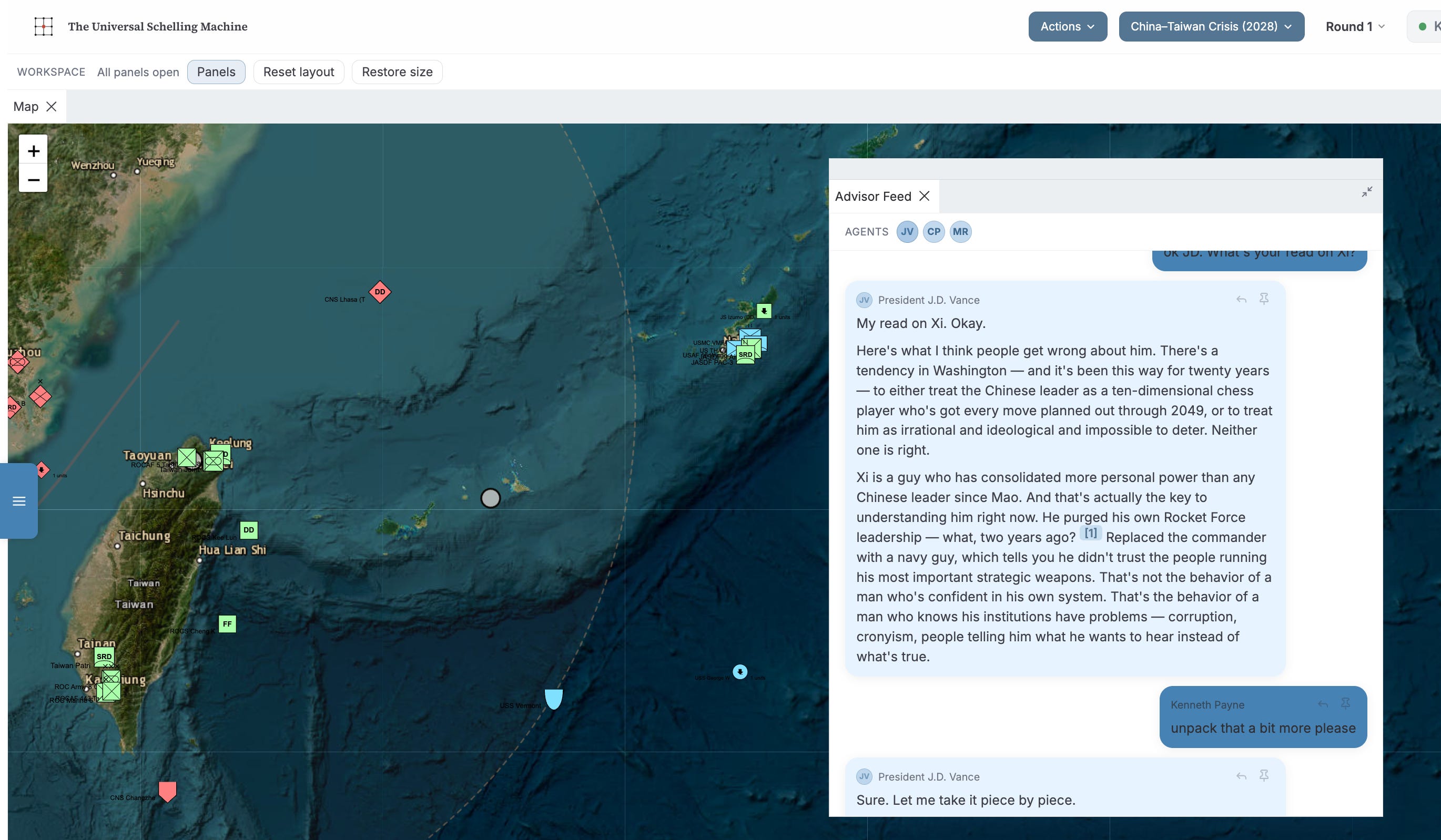
That’s right - it’s 2028, and President Vance is on deck, navigating a crisis in the Taiwan straights. How would he react? Who knows, but right now he’s reacting well in my simulation. This is the first time I’ve deployed some of my rich psychological characters in the Universal Schelling Machine. So far, so good - no nuclear war.
To build Vance-bot, I drew on the tape. I wanted lots of unscripted dialogue; not his pre-packaged speeches or memoirs. It’s my (and more importantly that of other psychologists’) contention that spontaneous speech like this can be used to derive meaningful psychological metrics. I’ve tested this on myself too - contrasting the findings with self-assessed tests.
So Vance-bot comes from public appearances between August 2016 and July 2026. These include not one but two Rogans, quality time with Tucker, the VP debate, and two Face the Nations. In all there’s some 145,000 words of transcript. I picked times when he’s unscripted and - because I’m interested in his performance as a strategist - when he talks international politics.
I do four different kinds of psych test on this data. A standard Big Five trait test: how outgoing are you? How anxious &etc. Then the ‘dark triad’ tests - narcissism (how much you need to be seen), psychopathy (whether you’re cold under pressure), Machiavellianism (are you strategic and calculating?). Then there’s a ‘dominance cluster’ — I test your view on social hierarchy, your need for closure, and the extent of your interpersonal dominance. Then lastly, for fans of political psychology, I extract your ‘operational code’ - a bunch of core beliefs you have about the way the world works. As we saw, Vance’s is pretty bleak.
When I say, ‘I tested’ - what i mean is a bunch of LLMS ran the tests and debated each other. I’ve described that setup before. What did they produce? 600,000 words of argument about Vance. That’s a big old biography. And lots of metrics too. I also had an LLM pipeline look extract his verbal style. This is much the same process that’s given me Macron-bot, Putin-bot, Trump-bot and the abortive Starmer-bot, last seen heading for a digital pint. All these can now be wired into the Schelling Machine, along with Vance’s Secretary of State Marco Rubio and a whole bunch of other real world actors.
The trench coat dilemma
Well sure - but am I really capturing the essence of Vance, or just putting Opus in a trench-coat? If you use LLMs you’ll know some like the construction ‘not X, but Y’ — and look, there’s one there in the screen grab from the USM!! Surely I’ve just but a thin veneer over the out-the-box model? But then we also know from the analysis that Vance talks like that too! What to do?
A: Do a synthetic interview with Vance-bot and then test that, of course. Sample interaction:
HOST: When journalists say democracy is under threat, what do you hear?
JD VANCE: I hear people projecting.
Not always. I want to be fair about this. There are serious journalists who are genuinely worried about institutional erosion, and I don’t think every person who raises that concern is acting in bad faith. Some of them mean it.
But when the phrase becomes a drumbeat — “democracy is under threat, democracy is under threat” — what I mostly hear is a class of people who are uncomfortable with the results of democracy. And there’s a difference. A big difference.
Because think about what actually happened. You had an election in 2016 that produced a result that the political and media establishment genuinely did not expect and did not want. And instead of saying, “Okay, we misread the country, we need to understand why sixty-some million people voted this way,” the response from a huge portion of the media and the institutional class was to say the result itself was illegitimate. Russia did it. The voters were manipulated. They were motivated by bigotry. And that frame — that the wrong people voted the wrong way and therefore something has gone wrong with democracy — that’s been the baseline ever since. And I find that pretty revealing.
Fun hey? Sounds like him too, at least to me. But what do we learn from 10,000 words of synthetic Q&A with Vance-bot? Well, let’s push it through the exact same pipeline that we used to create him originally, and glean the psychological metrics. Then we can contrast Vance-bot with Synthetic Vance-bot. Very meta.
Here’s the data: you can see that we got pretty damn close to one of his registers. 1
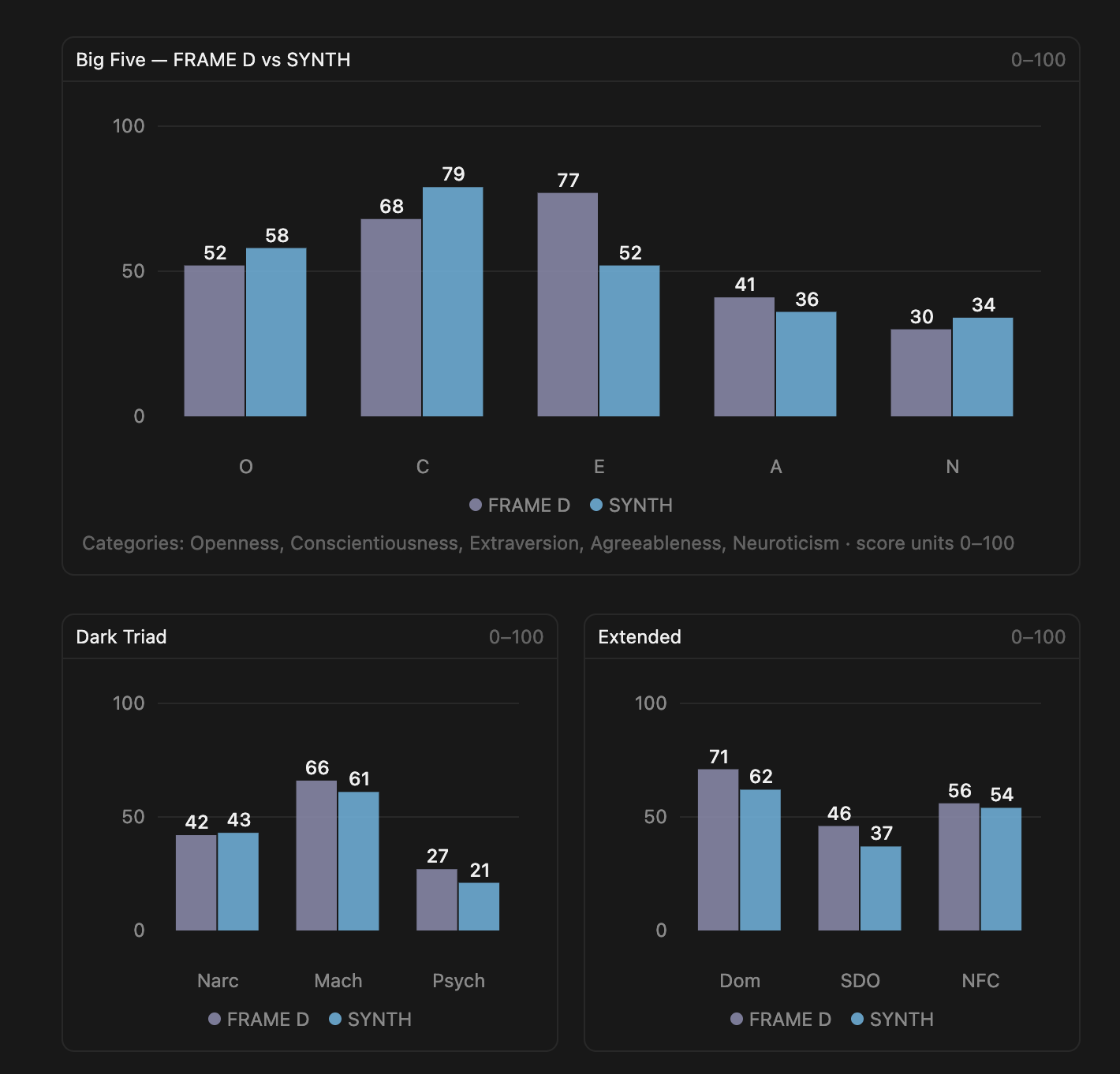
You’ll see that the biggest miss is extraversion. Synthetic Vance is too serious, the LLM shrinks ruled. That’s ok for now: there’s nothing more serious than thermonuclear war. S-Vance is statistically closer to the registers that are engaged when V-bot talks about war and politics than when he discusses family and friends. This likely reflects the instructions I gave the model to take things seriously, so really it’s my fault. But overall, I’m happy - this is recognisably the same person.
Indeed, Synthetic Vance-bot sits neatly within the psychological space of Vance-bot. And that, in turn, gives me some confidence that Vance-bot fits within the psychological space occupied by the real Vance. Bare minimum it means the Opus version of Vance is more Vance, less Opus.
The research continues, and so does the simulation/wargame. Last word to Vance-bot:
The part I'd push back on hardest is the framing of Machiavellianism. "Near-total absence of impulsive slips, itself suggestive of high functional Machiavellian ability." I mean, come on. The idea that someone who doesn't say stupid things on camera must be calculating — that tells you more about the writer's priors than about me. Some people just think before they talk. That's not a dark triad trait. That's being an adult. And wrapping it in clinical language makes it sound more scientific than it is.
I'd tell the writer: publish it, it's interesting, but be more careful about what you're actually claiming. And if you're going to put words in my mouth during a Taiwan crisis, at least get the Strait right. It's singular.
What do I mean by register? Well, as Whitman put it, ‘I am large, I contain multitudes’ — change the context, change the facets of your personality that emerge most prominently.For reasons that have to do with any unscrupulous researchers pinching my methodology, I’ll say no more about that here….